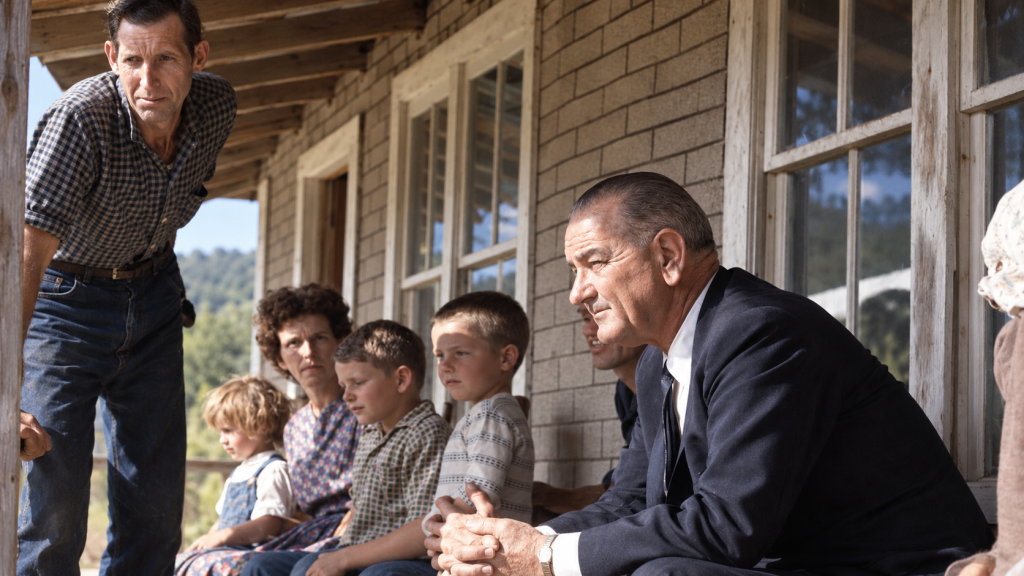
A porch beside Rock Castle Creek became one of the most recognizable places in America on April 24, 1964. President Lyndon B. Johnson had come to Martin County, and a conversation with the Fletcher family would help turn a national argument about poverty into something people could see. [3]
For those of us with roots here, the photograph carries a particular weight. This is our county: a place of homeplaces, family histories, and people whose lives continued long after the presidential party left. Remembering that day means looking closely at the famous image—and listening for the voices around it.
A promise made before the helicopter arrived
Johnson’s visit is often remembered as the beginning of the War on Poverty. The chronology matters. He had already declared an “unconditional war on poverty” in his State of the Union address on January 8, 1964. In that speech, he specifically named Appalachia among the places requiring attention. [2]
The April trip brought the president’s promise to eastern Kentucky. Inez became a place where Americans could connect a policy debated in Washington with a household, a conversation, and a community.
That is part of the visit’s lasting power. A speech can sound distant. A president sitting down at someone’s home asks a different question: what will this promise mean for the people who live here?
At the Fletcher home
Lady Bird Johnson’s diary records a helicopter journey from Huntington, West Virginia, to near Inez, followed by a drive to the Fletcher home along Rock Castle Creek. [1]
The Fletchers had eight children. Tom, a former miner, was getting occasional sawmill work. [1]
White House photographer Cecil Stoughton’s photographs preserved the encounter. In one familiar view, Johnson leans forward on the porch, the Fletcher family close beside him. The setting is modest, the conversation intimate, and the office of the presidency suddenly feels very far from its usual surroundings. [3]
There is a reason the picture has been reproduced so often. It brings national power and an ordinary family into the same frame. There is also a reason to look beyond its symbolism: the Fletchers were people, with relationships and a future of their own.
The voices beyond the photograph
Lady Bird’s diary offers another perspective that deserves a place in the story. She described the family as welcoming and dignified, and recalled telling the president, “This mustn’t be a sideshow for these people.” [1]
She also spoke with a local woman who ran a store and supported four children while her husband was ill. Asked what the community most needed, the woman emphasized jobs and a hospital. She described young people leaving for work elsewhere. [1]
Those concerns widen the meaning of the visit. Residents were talking about the conditions that allow a family to build a life: reliable work, access to care, and a reason for the next generation to stay.
That local voice deserves to remain beside the famous presidential photograph. It gives the community a speaking part in its own history.
Inez and Paintsville: two parts of the same day
The trip continued in nearby Johnson County. Lady Bird’s account records a visit to the Mayo vocational school in Paintsville. Later, Johnson spoke from the steps of the Johnson County Courthouse. That courthouse address was in Paintsville; it should not be confused with the visit to the Fletcher home near Inez. [1][4]
In his speech, Johnson referred to having just come from Martin County. He discussed coal employment, education, training, and the opportunity to earn a living. Of the people he had met, he said, “They want a fair chance to get ahead.” [4]
That phrase is a useful way to understand the day. The issues extended beyond immediate need to the opportunities a community could offer its people. Johnson’s remarks linked the visit to a broader federal effort, including education and medical care. [4]
What followed the visit
On August 20, 1964, Johnson signed the Economic Opportunity Act. The legislation became a central part of the War on Poverty, supporting efforts that included job training and community action. The Inez visit belongs within that larger history of debate, legislation, and implementation. [5]
The following year brought another significant development for the region. Johnson signed the Appalachian Regional Development Act on March 9, 1965, establishing the Appalachian Regional Commission. Its roots also reached back before the Inez trip, to the President’s Appalachian Regional Commission created under John F. Kennedy in 1963. [6]
These dates help us remember the scale of the work. One presidential visit could draw attention and build support. Lasting changes depended on laws, institutions, local decisions, and years of effort.
Remembering the day without reducing the place
The porch photograph became a powerful national image of Appalachian poverty. Photographer Roger May’s Looking at Appalachia project, launched decades later, challenged the narrow visual story that such familiar images could leave behind and invited a broader view of the region. [3]
That is a valuable challenge for a Martin County website, too. We can preserve the history of hardship while also recording music, businesses, teachers, celebrations, family stories, and the everyday work of keeping a community going.
Johnson’s visit deserves a place here because it joined Martin County’s history to a major moment in American public life. The people who welcomed him deserve a place here for their own sake.
April 24, 1964, was the day a president came to Inez. The fuller story belongs to the people who called it home before he arrived, and to those who have called it home ever since.
If your family has memories, photographs, or documents connected with the visit, we would welcome the chance to learn more. Please share what you know through our Contact page, including who created any photographs and whether you have permission for us to publish them. Family recollections can add valuable detail when clearly identified alongside the historical record.
Sources and further reading
1. LBJ Presidential Library — Lady Bird Johnson’s diary, April 24, 1964 (transcript)
2. LBJ Presidential Library — State of the Union address, January 8, 1964
5. LBJ Presidential Library — Remarks upon signing the Economic Opportunity Act, August 20, 1964
6. Appalachian Regional Commission — ARC’s history and work in Appalachia
Leave a Reply
You must be logged in to post a comment.